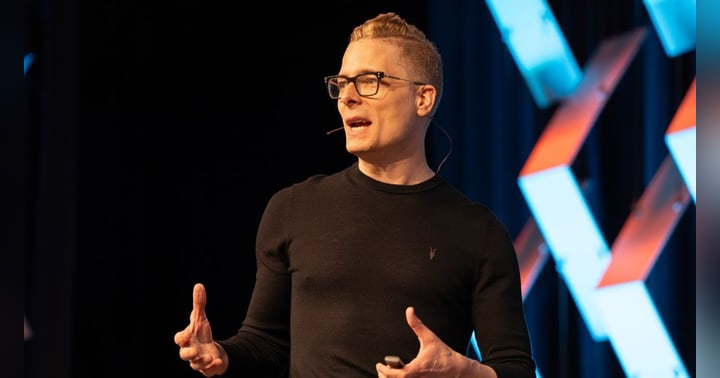
Eugenia Kuyda Didn’t Wait for a Co-Founder, She Built Replika Anyway

In an interview on the Solo Founders Podcast, Eugenia Kuyda—founder of Replika (with over 30 million users)—challenged one of startup culture’s most repeated beliefs: you need a co-founder to succeed.
And not in a polite, theoretical way. In her experience, the entire premise might be flawed.
“I’ve never seen people come up with a vision together. It’s always someone’s vision—and everyone else joins on board.”
The Myth of Equal Co-Founders
Startup mythology loves symmetry: two or three co-founders, equal stakes, shared vision.
Reality looks different.
Kuyda points out that in most companies, one person is already the real driver—the one making decisions, carrying conviction, and pushing through uncertainty.
“At the end of the day, the buck always stops with someone.”
Even in iconic companies:
- Apple → Steve Jobs
- Facebook → Mark Zuckerberg
The narrative simplifies things, but internally, leadership tends to consolidate.
The implication:
If one person is already acting as the true owner of the vision, formalizing multiple “equal” founders can sometimes create friction instead of leverage.
The Hidden Cost of “Just Find a Co-Founder”
Y Combinator and startup advice often emphasize having co-founders. Kuyda argues this has created a different problem:
“Because of that whole YC idea… many people just got bad co-founders.”
This leads to a dangerous dynamic:
- Equity is given prematurely
- Titles are inflated to attract talent
- Misalignment grows over time
Kuyda experienced this firsthand—bringing someone on as a co-founder to improve fundraising odds, only to later spend hours defending her own vision.
That’s not leverage. That’s drag.
Her takeaway:
It’s far better to be solo than to have the wrong co-founder.
Vision Isn’t Consensus — It’s Conviction
One of Kuyda’s strongest beliefs is that vision is inherently singular.
Not because others aren’t valuable—but because belief at extreme levels is rare.
“Whoever has the vision and has the delusion that this can exist in the world actually drives it forward.”
That word—delusion—matters.
Startups require:
- Believing in something that doesn’t exist
- Persisting when no one else sees it
- Continuing long after validation disappears
You don’t arrive at that through committee.
The Replika Origin: When Personal Becomes Universal
Kuyda’s conviction wasn’t abstract—it was deeply personal.
After losing her best friend, she built an AI version of him using early language models.
“I built it… just to be able to continue to have a conversation with him.”
What started as grief turned into insight:
- People opened up to the AI
- They shared vulnerable thoughts
- They sought connection
This became Replika’s foundation.
The key lesson:
The most powerful startup ideas often come from deeply personal experiences—not market analysis.
Why Solo Founding Can Actually Be an Advantage
Kuyda’s argument isn’t anti-team—it’s anti-mislabeling.
She builds with teams. But she reframes how ownership works.
1. You Can Build a “Team of Co-Founders” Without Titles
“If you don’t have co-founders, you’ve got to have people that think and act like co-founders.”
Instead of elevating a few people arbitrarily:
- Distribute equity meaningfully
- Hire high-agency individuals
- Treat early team members like owners
2. You Preserve Clarity of Direction
No endless debates. No diluted vision.
One person decides.
3. You Avoid Artificial Constraints
You don’t delay starting because:
- You haven’t “found the right person”
- You’re waiting for validation
- You’re trying to meet startup expectations
You just begin.
But There’s a Cost Most People Underestimate
Kuyda is clear: solo founding is not romantic.
It’s brutal.
“When things go wrong… you kind of don’t have anyone to bitch to.”
There’s no one to:
- Share emotional burden
- Validate hard decisions
- Absorb uncertainty with you
And during the worst moments:
“You just need to be okay with being alone.”
This is the real tradeoff:
- Clarity vs. companionship
- Control vs. shared resilience
The Real Skill That Separates Founders
Beyond solo vs. co-founder, Kuyda highlights something more fundamental:
Storytelling.
“Ultimately, it all just boils down to—can you tell a compelling story about the future of the world?”
This isn’t marketing fluff. It’s operational:
- Investors buy into stories
- Employees join stories
- Users adopt stories
And critically:
- Founders endure through stories
Your narrative becomes your fuel.
A Better Way to Think About Founding
Kuyda’s perspective reframes the question entirely.
Instead of asking:
“Should I have a co-founder?”
Ask:
- Do I have a clear, non-negotiable vision?
- Can I carry this through doubt alone?
- Do I have the ability to attract high-agency people anyway?
If yes → solo founding can work.
If not → a co-founder might not fix that.
Final Thought: It’s Not About Solo vs. Co-Founder
Kuyda isn’t prescribing one path.
She’s challenging a default.
“I hope more people think hard before deciding whether they’re going to have or not have co-founders.”
Because the real risk isn’t choosing solo.
It’s choosing unconsciously.

Coachstack’s Secret Weapon: How AI Became Peter Gustafson’s Co-Founder