Jessica Valenzuela on Outsmarting the Hustle with Smart Marketing
Jessica Valenzuela's entrepreneurial spark ignited at age seven with a classroom candy hustle—and it never dimmed. From building digital experiences for global brands to founding Mowie AI, she’s always been driven by a deep instinct to solve friction points. In this Wantrepreneur to Entrepreneur Spotlight feature, Jessica shares how her early scrappiness evolved into a bold mission: to democratize elite-level marketing for SMBs using AI. Her story is one of pivots, persistence, and powerful insight—where childhood lessons meet cutting-edge tech to empower the next generation of marketers.
Hi, Jessica! Thanks for joining us today. Tell us about your business. Who do you serve, how do you serve them, and what's the impact that your business and work makes?
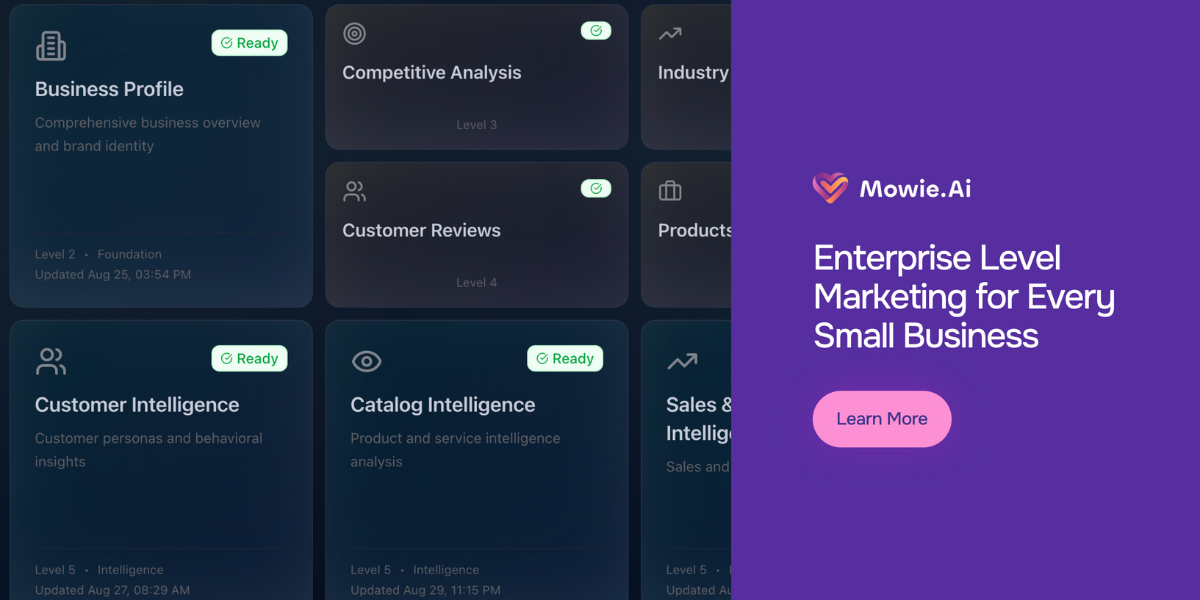
Mowie AI is building an AI-powered marketing intelligence platform that brings Fortune 500-level marketing capabilities to small and medium-sized businesses. We're solving the critical gap where 73% of SMBs lack confidence in their marketing strategies and waste 26% of their budgets on ineffective channels, by automating data gathering, customer segmentation, content creation, and campaign management through machine learning.
Tell us about the moment you finally felt like you went from wantrepreneur to entrepreneur.
Entrepreneurship might be in my DNA. My mom co-owned and managed both a Japanese restaurant and a precious metals jewelry business, and I watched her build from the ground up.
My first venture launched at 7 years old. I noticed my classmates loved chocolates, but the school canteen was a 10-minute round trip and charged $0.25 per piece. So I asked my mom to buy a bag of Choco-Nuts, did the math—$0.05 cost per piece—and sold them for $0.10-$0.15 right in the classroom.
The profit was nice, but what stuck with me was watching my classmates' faces light up. They weren't just buying chocolate; they were paying for convenience. That 7-year-old learned three things that still drive me today: spot the friction, test the solution, and bring people along who believe in the vision.
Describe the moment or period in your life/career that motivated you to make the entrepreneurial leap.
2007. New York City. Digital advertising producer by day, restless entrepreneur by night.
I was building digital experiences for big brands, but I wanted to build something of my own. My friend Peter March and I would meet up to brainstorm product ideas, searching for the right problem to solve.
Then the pattern I'd seen at 7 years old resurfaced: pain is an opportunity.
As a producer, I was constantly scrambling to find designers and developers who could deliver on impossible deadlines. Local freelancers were charging $200-300/hour—this was the boom era when anyone who could hand-code HTML was printing money. Projects that "needed to be done yesterday" were bleeding digital advertising budgets dry.
But I had access to what most resource teams at ad agencies didn't: a vetted network of offshore and local talent I'd built over years. I'd already proven the model worked, I'd brought together international teams to deliver Gwen Stefani's website with full sweepstakes integration, on time and on budget.
The gap was obvious. Agencies needed execution muscle they could trust. I had the network and the production chops.
So I started a digital production agency serving other digital agencies. We became their secret weapon, the team that could take on the crazy projects with the impossible timelines and actually ship them.
That itch I was scratching? It wasn't just about building my own thing. It was about solving the same problem for dozens of other producers who were living my pain every single day.
Describe a tool, service, or software that has been a game-changer for your business. How does it contribute to your success?
Learning how to unlock the power of LLMs like Claude for tasks like creating a fundraising and sales pipeline, demand generation workflows and inbound and outbound marketing automation is a game-changer. In the past you needed a human to research and curate your lead generation which took too long. Today, a two-person team can source leads, build an opportunity and conversion pipeline all in one simple workflow.
We know that success is very often a non-linear path. Tell us about a failure, pivot point, or lesson that changed your course or direction and helped to get you where you are today.
Claude (and LLMs in general) fundamentally changed what a two-person team can accomplish.
Before: Lead generation meant hiring researchers to manually find prospects, qualify them, and build outreach lists. It was slow, expensive, and didn't scale.
Now: We use Claude to build our entire go-to-market engine—fundraising pipeline, sales outreach, demand gen workflows, inbound and outbound automation. What used to require a team of 5-6 people now runs with two.
Here's the unlock: It's not about replacing humans with AI. It's about compressing time. We can research 10K potential partners in an afternoon, generate personalized outreach that actually resonates, and iterate on messaging in real-time based on response data.
For Mowie, this isn't just a productivity hack—it's our proof of concept. We're building an AI-native marketing platform because we've lived the transformation firsthand. When your co-founder can go from idea to working sales pipeline in hours instead of weeks, you realize the old way of marketing is over.
What unconventional strategy did you employ that significantly impacted your business?
Early on, GoGoGuest's MVP included proprietary hardware. If we'd stayed on that path, we wouldn't exist today—the capital requirements and support burden would have crushed us.
The pivot came when we onboarded our first paying customer using their existing Cisco Meraki access point instead of our hardware. That decision—focusing on software that worked with what venues already owned—changed everything.
Eight years later, that first customer is still with us. That's the real validation: not that we sold them once, but that the value kept compounding long after the hardware decision became irrelevant.
Similarly with Mowie AI, in our MVP phase we've had to redo the architecture and flow of our product to make it even more magical for marketers.
What’s something you wish you knew sooner that you’d give as advice for aspiring or newer entrepreneurs?
When I started GoGoGuest, I was so naive about how difficult it would be to start a company and build a technology product without a technical co-founder. Today, it seems friendlier to pursue a technology product idea thanks to AI powered solutions and tools.
Want to dive deeper into Jessica's work? Check out the links below!
- Visit Mowie AI's website: mowie.ai
- Connect with Jessica Valenzuela on LinkedIn: Jessica Valenzuela
- Follow Mowie AI on Instagram: @trymowieai
- Follow Mowie AI on LinkedIn: Mowie AI
- Visit GoGoGuest's website: gogoguest.com
- Follow GoGoGuest on LinkedIn: GoGoGuest
How NeutronTech is Defying Industry Norms with On-Device AI Innovation