Rory Sutherland on Marketing Psychology: Why the Smallest Changes Create the Biggest Business Wins
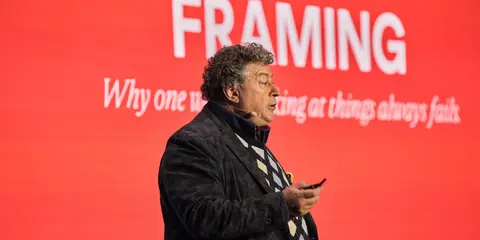
What if the biggest opportunity to grow your business isn't improving your product, lowering your prices, or spending more on advertising—but changing how customers perceive what you already offer?
That's the provocative idea behind advertising legend and behavioral psychology expert Rory Sutherland's approach to marketing.
In his appearance on My First Million, in a conversation shared under the title Rory Sutherland: Completely Legal Marketing Hacks That Always Work, Sutherland challenges one of entrepreneurship's most deeply ingrained assumptions: that creating more value always requires building something objectively better.
Instead, he argues that extraordinary business results often come from understanding the irrational, emotional, and frequently overlooked ways people make decisions.
For wantrepreneurs and early-stage founders, his insights offer something particularly valuable: a way to compete with larger, better-funded companies without playing by their rules.
Here are seven lessons from Sutherland's unconventional approach to marketing—and how you can apply them to your own entrepreneurial journey.
1. Stop Making Better Products. Start Making Products More Desirable.
"There are two ways of making money. You can either make desirable things, or you can make things desirable."
This single observation captures Sutherland's entire marketing philosophy.
Most businesses approach growth from an engineering perspective. They believe improving functionality, increasing efficiency, or adding features automatically makes a product more valuable.
But customers don't experience value through spreadsheets. They experience it psychologically.
Consider Sutherland's example of James Watt and the steam engine.
When Watt was selling steam engines to mine owners, he faced a problem: potential buyers didn't particularly care about technical specifications.
They cared about how many horses they could replace.
So Watt developed a way to communicate the engine's capabilities through horsepower.
Instead of selling an unfamiliar technology, he translated its benefits into something customers already understood.
The entrepreneurial lesson: Your customers don't necessarily want to understand how your product works. They want to understand what it changes in their lives.
If you're selling AI software, don't lead with model benchmarks. Explain how many hours of repetitive work it eliminates.
If you're selling consulting services, don't emphasize your methodology. Show the decisions your clients will finally feel confident making.
The right explanation can be as valuable as the right invention.
2. Your Biggest Competitive Advantage Might Be Something Nobody Measures
Sutherland introduces a fascinating concept he calls reverse benchmarking.
Traditional benchmarking involves studying competitors and trying to match or exceed their performance.
Reverse benchmarking asks a different question:
What is everyone in my industry completely ignoring?
Sutherland highlights restaurateur Will Guidara's approach to hospitality.
Rather than copying everything exceptional about a world-class restaurant, Guidara asked his team what had been disappointing.
Their answers? The coffee wasn't particularly memorable, and beer drinkers received less attention than wine enthusiasts.
Instead of accepting those weaknesses as industry norms, Guidara invested in making those neglected experiences exceptional.
It's an approach entrepreneurs can apply almost anywhere.
Imagine a bookkeeping company that prioritizes explaining financial statements in plain English. Or a web design agency that makes client onboarding dramatically easier.
Neither necessarily needs better technical capabilities.
They simply need to become exceptional at something customers appreciate but competitors overlook.
Try this: List five things customers regularly tolerate in your industry. Choose one that your competitors rarely discuss, and explore what it would take to make it your signature strength.
3. Fix Customer Anxiety Before Spending Money on Product Improvements
One of Sutherland's most revealing examples involves electric vehicles.
His larger electric car had approximately 58 miles of remaining range, yet its dashboard showed just 16% battery.
He felt anxious.
Meanwhile, his wife's smaller electric car could display roughly the same remaining mileage at 56% battery—and he felt perfectly comfortable.
Same practical driving distance. Completely different emotional reaction.
The underlying problem wasn't necessarily battery capacity.
It was perception.
Sutherland asks whether reducing customer anxiety might sometimes be more economical than engineering a technically superior product.
For entrepreneurs, this raises an important question:
Are your customers dissatisfied with your product—or uncertain about using it?
A customer might hesitate to book your service because they don't know what happens after payment.
Someone might abandon checkout because delivery expectations aren't clear.
A prospective client might avoid contacting you because they fear an uncomfortable sales conversation.
Before investing in another feature, identify the uncertainty keeping customers from moving forward.
Sometimes reassurance is your most valuable product improvement.
4. Small Marketing Experiments Can Create Outsized Results
Sutherland's early career in direct-response advertising taught him that seemingly insignificant details can dramatically influence customer behavior.
He recalls a marketing experiment involving telephone services in the early 1990s.
Customers received one of three offers:
- Respond by mail only.
- Respond by telephone only.
- Choose between mail and telephone.
The results were striking.
Mail-only offers generated a 5% response rate. Telephone-only offers generated 2%. Providing both options increased responses to approximately 7%.
Nothing fundamental about the product changed.
The difference was how customers could respond.
This illustrates a crucial lesson for small-business owners: friction can destroy demand that already exists.
Your landing page might be convincing, but your booking process could be confusing.
Your offer might be compelling, but customers may dislike the payment options.
Your emails might generate interest, but your call to action could feel intimidating.
Try this: Run one small experiment this week. Test a different headline, introduce another contact method, clarify your delivery timeline, or simplify your booking process.
Measure whether behavior changes.
You don't need a massive advertising budget to discover meaningful psychological advantages.
5. People Don't Just Buy Products. They Buy Emotional Certainty.
Another powerful example comes from Sutherland's work with American Express.
The company wanted more customers to upgrade to its prestigious Gold Card.
Traditional marketing focused on communicating the card's benefits.
But a client recognized something more fundamental: many customers already wanted the card.
What stopped them was fear of rejection.
The solution was to shift the message from applying for membership toward receiving a card for which they were effectively pre-approved.
The product remained the same.
The psychological experience changed dramatically.
For entrepreneurs, this distinction is especially important when selling premium services.
Customers don't always need additional convincing that your solution is valuable.
Sometimes they need reassurance that they're eligible, welcome, or making a safe decision.
A consultant might replace an intimidating application process with an invitation to discuss fit.
A membership business might emphasize who its community welcomes rather than how selective it is.
The opportunity isn't necessarily to make your offer more attractive.
It's to make accepting it feel less risky.
6. Being Different Beats Being Better at Everything
Sutherland points to Red Bull as an example of a business that would have been difficult to justify through conventional market research.
A small can. A relatively high price. A taste that wasn't universally appealing.
By traditional beverage-industry standards, those characteristics might have looked like disadvantages.
But Red Bull didn't win by competing on the same dimensions as ordinary soft drinks.
It created a different proposition.
Sutherland makes a similar argument about Moxy Hotels.
The rooms are smaller, and several traditional hotel amenities are absent. Instead, the experience prioritizes lively communal spaces, convenient amenities, and an atmosphere suited to shorter stays.
Those limitations become understandable because customers know what they're choosing.
The broader principle is simple:
You don't need to satisfy every customer. You need to become unusually attractive to the right customers.
For a startup, this can be liberating.
Instead of trying to offer the most features, the lowest prices, and the highest level of service simultaneously, identify the trade-offs your ideal customers are genuinely willing to make.
Build around those preferences.
Distinctiveness can protect you from competing exclusively on price.
7. Your Intuition Is an Asset—If You're Willing to Test It
Perhaps Sutherland's most important message concerns how entrepreneurs make decisions.
He argues that established businesses often become excessively dependent on data and rational justification.
The problem?
Historical data describes what has already happened. It cannot fully reveal opportunities that nobody has explored.
This creates an advantage for founder-led businesses.
Small companies can pursue unconventional ideas without navigating endless committees or defending every experiment through established metrics.
But Sutherland isn't suggesting that entrepreneurs abandon evidence.
He's advocating a different relationship between intuition and analysis.
Use intuition to identify possibilities worth exploring.
Use experimentation to discover whether they work.
And use evidence to improve or abandon them.
For founders, that means protecting time for ideas that initially seem unusual.
The unconventional positioning strategy, the forgotten advertising channel, or the neglected customer frustration might contain your next breakthrough.
As Sutherland puts it:
"Invention isn't an innovation until it changes behavior."
That distinction should change how entrepreneurs think about growth.
Your business isn't rewarded simply for making something impressive.
It's rewarded when people recognize its value and behave differently because of it.
The Bigger Lesson: Marketing Is About Understanding People
The common thread running through Rory Sutherland's ideas is that business growth doesn't always require more resources.
Sometimes it requires a different question.
Instead of asking, How can we make our product better? ask, What would make customers feel better about using it?
Instead of asking, How do we outperform competitors? ask, What are our competitors completely ignoring?
And instead of assuming customers make decisions logically, become curious about the emotions, expectations, and uncertainties shaping their behavior.
For wantrepreneurs, this is encouraging news.
You don't need a massive team or a revolutionary invention to create something valuable.
You need to observe what other businesses overlook, experiment with what others dismiss, and understand the people you're trying to serve.
Because sometimes the most powerful marketing innovation isn't changing what you sell. It's changing what customers see.
Luca Ferrari’s Bending Spoons Playbook: How to Build a High-Performance Company With Less